
 DEMO
DEMO





How Rise of Olympus Extreme works
The spec sheet is complete: RTP 96,2 %, high volatility, 50.000 x. The feature list points to cluster wins, avalanches, symbol removal and wilds with multipliers. It's a game where the individual mechanics actually work together to reach the high ceiling, unlike titles where features are stacked without internal logic.
01Play'n GO ramps up a familiar formula
The original series was built on the idea that Zeus, Poseidon, Hades and Athena could each intervene on the grid in their own way. The Extreme edition preserves that architecture — the feature list mentions Remove Symbols and Symbol Swap, which are precisely the two interventions the gods perform: remove a symbol type from the board or transform one type into another.
Those kinds of interventions are interesting because they are not random rewards but changes to the composition of the grid itself. When a low-paying symbol type is removed from the board, the probability that the next cascade hits something valuable increases. It's a mechanic with built-in momentum.
96,2 % is a decent value for a Play'n GO game, but I also note the RTP range on the sheet. The studio delivers several configurations to operators, and the percentage you get isn't necessarily 96,2. Check it in the game's information screen.
02The clusters and the removed symbols
Cluster Pays means that wins are formed by contiguous groups of identical symbols rather than by lines from left to right. Combined with Avalanche and Cascading this creates a chain reaction: a cluster pays, the symbols disappear, new ones fall down, and there is a chance that a new cluster is formed from the ensuing field.
On top of that there are Multiplier, Free Spins Multiplier and Wilds with multipliers. Three layers of multiplication are a lot, and it's a significant part of the explanation for how a ceiling of 50.000 x can be mathematically possible at all. It requires several things to fall into place in the same round.
Additional Free Spins are also listed, which means the round can be extended during play. In cluster games with cascades it's often there that big outcomes occur: an extended round with a high multiplier level already built up.
03What 50.000 x costs in blank spins
There is a price for such a high cap, and it's paid in the base game. High volatility in a cluster game means you can sit through many rounds where the cascades stop after one or two steps without hitting any paying outcome. It's not a bug in the game, but a direct consequence of how the budget is allocated.
For the player it means the stake size should be chosen according to session length and not per individual spin. A game of this type requires more spins to approach its theoretical percentage than a low-volatile game does. Set a limit in advance — the operator's stake limits and ROFUS exist for that purpose.
On the other hand, I think Play'n GO are honest about it. 'High' is clearly indicated on the sheet, and there has been no attempt to dress up the relationship between the ceiling and the risk.
04Where Extreme sits in the field
Among the Olympus titles in the catalogue, this is one of the few where RTP, volatility and the cap are all disclosed and where the feature list hangs together logically. That alone lifts the title above much of the field, which consists of genre copies with holes in the spec sheet.
The theme list mentions harp, mountains, Poseidon, weapons and a light blue palette. That points to a visual direction closer to the airy than the dark, stormy look many competitors choose. It's a welcome difference in a genre where too much looks the same.
There should, however, be room for skepticism: Extreme variants of popular series are often mainly a ramping up of variance rather than a truly new game. If you knew the original and thought it was too punishing, this one won't be any gentler.
Screenshots from Rise of Olympus Extreme
 Screenshots from Rise of Olympus Extreme
Rise of Olympus Extreme from Play'n GO is shown with BET 1,00 and a balance around 24.990. To the left of the grid sits the multiplier ladder, which moves up one step for each tumble: it showed x1, x2, x3, x4, x5, x6 and x7 during the demo.
The wins come from tumbles. A single drop produced a partial win of 0,30, and with the ladder at x3 the spin ended on WIN 1,20. Later with the ladder at x5 the result was WIN 2,00 — all at a stake of 1,00.
The game requires an extra long server load time; after 65 seconds of waiting the WebGL client rendered correctly and the reels responded normally to spins.
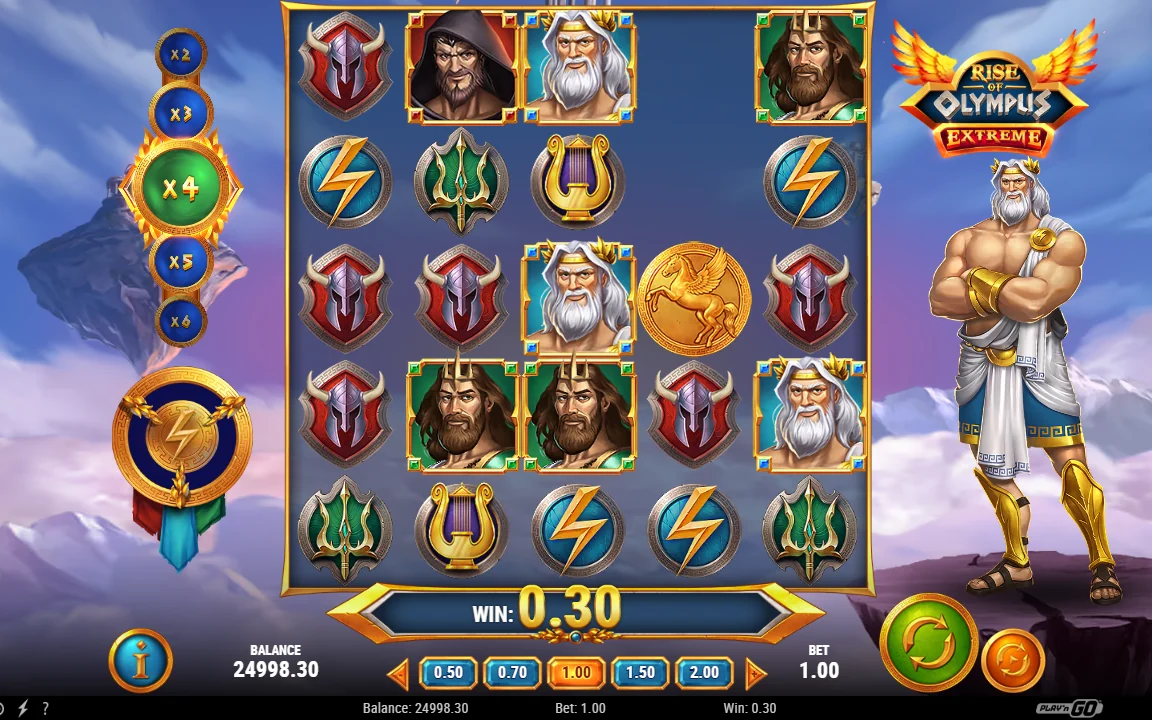
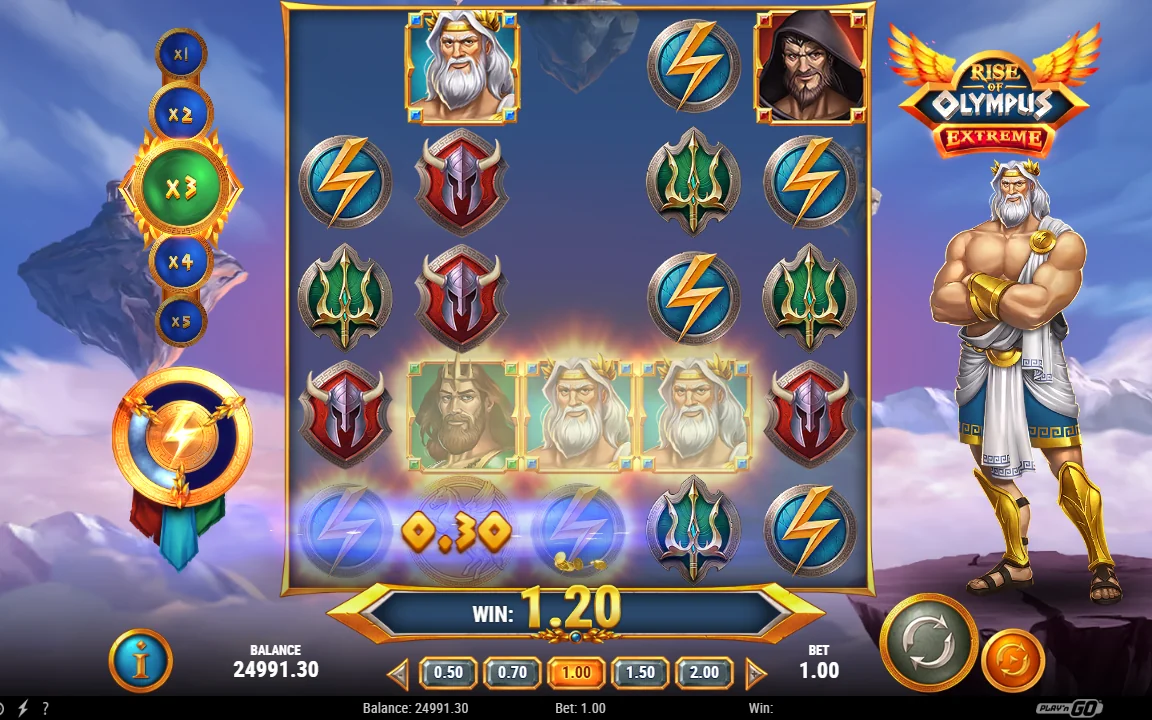
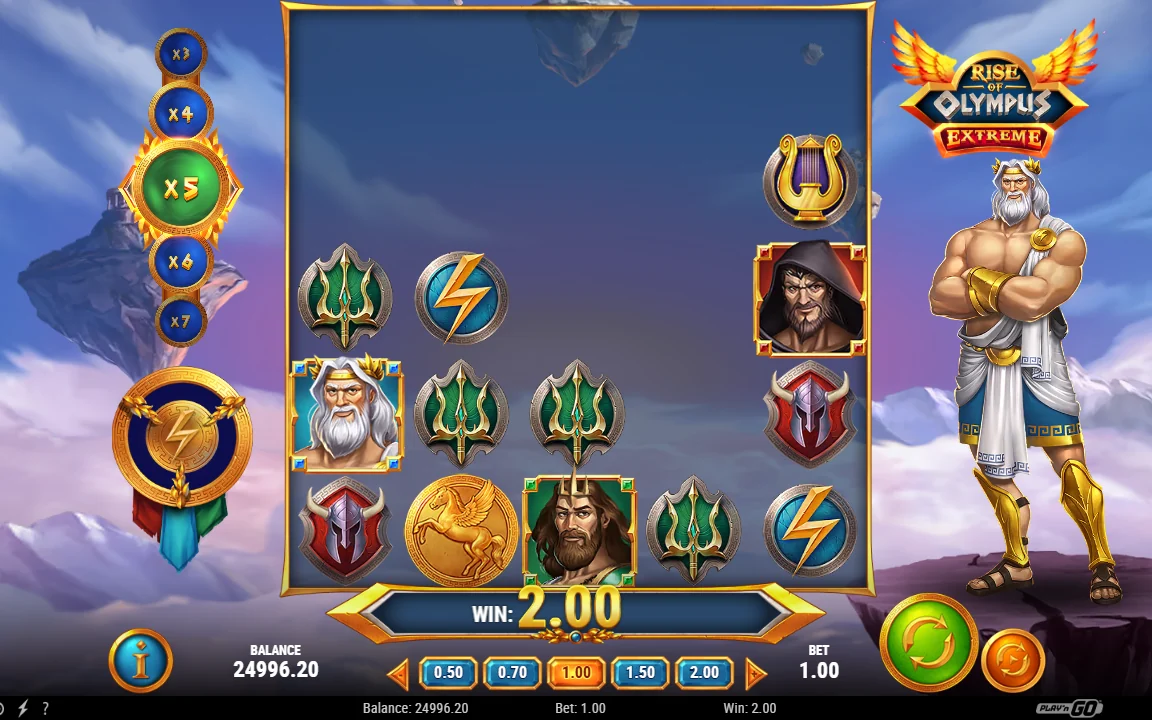
The images are our own captures from the provider's demo version of the game. The values in the tables above still come from our catalog data.
Game rules
 Game rules
Base game
The game runs on the provider's standard setup. The published return to player is 96,2 %, and the volatility is listed as high.
Round extension
If more scatters land during the free spins round, it is extended with extra spins. That's the mechanic that makes long rounds possible.
Avalanche mechanic
The reels clear winning symbols and let new ones fall down from above. One paid combination can thus turn into a longer sequence.
Cascades
Symbols in a win are removed, and new ones fall down instead. The chain continues as long as new wins are formed by the fallen symbols.
Cluster Pays
Wins are formed by contiguous clusters of matching symbols instead of lines.
Multiplier in free spins
In the free spins round a multiplier is added on top of the wins. The value typically increases through the round instead of resetting between spins.
Multipliers
The game uses multipliers that multiply the win they are part of. Where and when they can land is determined by the game's own paytable.
18+ · Play for entertainment, and set limits before you play. If you need help: stopspillet.dk / 70 22 28 25 — or self-exclude via ROFUS.
Key figures and payouts
| Key figures | Value in our catalog data |
|---|---|
| RTP according to catalog data | 96,2 % |
| Volatility | High |
| Max win | 50.000× |
| Ways to win | Not disclosed |
| Reel set | Not disclosed |
| Min. indsats | 0,1 € |
| Max. bet | Not disclosed |
| Win frequency | Not disclosed |
| Provider | Play'n GO |
| Released | 2. september 2025 |
The exact multiplier values per symbol count appear in the game's info panel and can vary with stake and operator. We reproduce only figures from our catalog data — not our own measurements in the game.
Similar slots
More from Play'n GO

More Olympus slots
 Treasures of Olympus 1000King Midas GamesRTP not specified · Max 15.000×
 Olympus GoldBetGamesRTP 96,53 % · Max 4.689×
 Olympus RivalsAmigo GamingRTP not specified · Max 1.700×
 Olympus Mania: Hot BonusFugasoRTP 96,25 % · Max 3.000×
 Olympus: Wine & WondersChampion StudioRTP not specified · Max 5.000×
 Olympus Glory Gods & Kings LinkEGT DigitalRTP 96,5 % · Max 4.280×
 Zeus Legends of OlympusInspired GamingRTP 94,5 % · Max 1.000×
 Olympus Power LinkFugasoRTP 96,15 % · Max win 10.000×
 Unusual Suspects: Legends of OlympusNorthern Lights GamingRTP 96,06 % · Max win 12.000×
 Olympus Wins Super ScatterPragmatic PlayRTP 96,5 % · Max 100.000×
 Olympus Storm Connectify Pays Power ComboGold Coin StudiosRTP 96,33 % · Max 5.000×
 Glory of Olympus XmasGameTimeTecRTP 96,18 % · Max win 2.500×
 Bolt of OlympusUU SlotsRTP 96 % · Max 1.000×
Same mechanics
 Olympus TruewaysBGAMINGRTP 96,84 % · Max 5.000×
 Games in Olympus 1000Pragmatic PlayRTP 95,51 % · Max 15.000×
 Gates of Olympus Super ScatterPragmatic PlayRTP 96,5 % · Max 50.000×
 Gates of OlympusPragmatic PlayRTP 95,51 % · Max 5.000×
 Supreme of OlympusBarbara BangRTP 96 % · Max win 15.000×
 Olympus ThunderholdRTGRTP 95,74 % · Max 2.500×
 Olympus Bonanza ClawClawbusterRTP 95 % · Max 10.000×
 Greek Goddess: Siege of Olympus MegawaysPlayziaRTP 96,06 % · Max win 5.000×
 Gods of Olympus: AresMount OlympusRTP 96,77 % · Max 5.000×
 Gods of Olympus: AphroditeMount OlympusRTP 96,89 % · Max 5.000×
 Zeus of OlympusPlayStarRTP not specified · Max not specified
 King of OlympusPlaytech OriginsRTP 95,47 % · Max 5.000×
 Sky of OlympusFormula SpinRTP 96,3 % · Max 15.000×
 Royalty of Olympus XmasBarbara BangRTP 96 % · Max win 15.000×
 Fortune of OlympusPragmatic PlayRTP 96,55 % · Max 10.000×
Same play profile
 Glory of Olympus: UnlockedGameTimeTecRTP 96,18 % · Max win 10.000×
 Olympus Coin LinkFugasoRTP 96,12 % · Max win 5.000×
 Olympus ExplosionRubyPlayRTP 96,37 % · Max not disclosed
 Chronicles of Olympus Assembl'emAlchemy GamingRTP 96 % · Max win 11.000×
 Lightning of OlympusSkywind GroupRTP 96,5 % · Max 15.000×
 Gems of OlympusGambitRTP 96,5 % · Max 5.000×
 Raging Gods: Olympus 2 Power ComboNailed It GamesRTP 96,12 % · Max win 5.000×
 1000 Olympus RivalsAmigo GamingRTP 96,08 % · Max win 2.500×
 Olympus LightningWizard GamesRTP 96,08 % · Max win 2.295×
 3 Combo OlympusFunky GamesRTP 96 % · Max win 15.000×
 Gates of Olympus RoulettePragmatic PlayRTP 97,3 % · Max 10.000×
 Rings of OlympusTurbo GamesRTP 97,34 % · Max 700×
 Aphrodite Legends of OlympusInspired GamingRTP 94,5 % · Max 5.000×
 Olympus UnleashedPush GamingRTP 94,36 % · Max 2.340×
 Olympus 7’s Dream DropRelax GamingRTP 94 % · Max 13.000×
Frequently asked questions
 Frequently asked questions
What is the RTP in Rise of Olympus Extreme?
96,2 % according to the provider's factsheet. The title does have an RTP range, so other configurations can occur at a given operator. Check in the game's information screen.
How much can you win at most?
50.000 times the stake. It requires that the avalanche, the free spins multiplier and multiplier wilds hit together in the same round.
How does Cluster Pays work?
Wins are formed by contiguous groups of matching symbols instead of paylines. Winning clusters are removed, and new symbols fall down into their place.
When was the game released, and who is behind it?
Play'n GO released Rise of Olympus Extreme on 2. september 2025 as a high-volatility variant of the studio's established Olympus series.
