

 DEMO
DEMO





How Treasures of Olympus 1000 works
The spec sheet gives high volatility and a ceiling of 15.000 x the stake. RTP, however, is not stated, and that is a shortcoming I'll return to, because it matters more in a game of this type than in most others. The feature list is telling, though: Avalanche, Cascading, Pay Anywhere, Random multiplier, Free Spins and Buy Feature.
01What the thousands figure in the title refers to
In the template this title is built on, random multiplier tiles pile up on the screen during the free spins round, and their values are added together when a winning combination lands. 1000 refers to the upper limit for a single such tile. Whether King Midas Games uses exactly the same steps is not described in the material I have.
What the feature list actually confirms is the Random multiplier and Free Spins Multiplier families of mechanics as well as Additional Free Spins, i.e. the ability to extend the round mid-play. Together with Pay Anywhere — where symbols pay regardless of position, typically at eight or more of the same kind — it's the classic recipe.
Pay Anywhere is worth noting for new players. There are no pay lines to keep track of. It changes how you read the screen: you count symbols, not rows.
02Cascades instead of reels
Avalanche and Cascading both appear on the list, which in practice are two names for the same principle: winning symbols are removed and new ones fall into their place, so one stake can produce several consecutive wins. It's the engine that makes the high multipliers meaningful because they can hit across multiple cascades in a row.
The consequence of cascade mechanics is a very skewed distribution of payouts. The base game rarely pays anything noteworthy, while the free spins round carries almost the entire budget. That is exactly what the label High volatility indicates, and you should take it literally.
On the other hand, that very structure makes the 15.000 x ceiling realistic as more than marketing. It's not a number you'll hit, but it's within the mathematical reach of the cascade mechanics, which isn't the case for all games that boast large multipliers.
03The buy button is titled
Buy Feature is present, and in a game where the base game exists mainly to finance the bonus round, the buy button is not a luxury but a real structural choice. Many players of this template use it exclusively. The price for Treasures of Olympus 1000 is not disclosed.
This is where the missing RTP hits hardest. Buy features typically have their own payout percentage, and when neither the base game's nor the buy's percentage is disclosed, you are effectively buying blind. I wouldn't do that. Check the figures in the game's information screen at the operator first.
If you're unsure about how much you're spending, set stake limits via the operator's tools before you open the buy menu. ROFUS and the Gambling Authority's frameworks exist precisely for situations where a single button can move spending significantly.
04What the provider does not tell
King Midas Games is not a name that features prominently in Danish game lobbies, and the combination of an unknown studio, a familiar template and an undisclosed RTP is not a good starting point. That doesn't make the game bad, but it shifts the burden of proof onto the player.
The theme list — ancient civilizations, gems, lightning, Zeus, Greece — is as familiar as the mechanics. No personal stamp has been applied to the world, and that's a shame when the setting actually allows room for it.
The assessment therefore lands somewhere in the middle: a technically coherent setup with a respectable ceiling, but without the one figure that makes it possible to decide whether the price is reasonable.
Screenshots from Treasures of Olympus 1000
 Screenshots from Treasures of Olympus 1000
Treasures of Olympus 1000 runs in vertical format, so the screenshots were taken in portrait mode on 12. august 2026 with a stake of 1 USD per spin. The game is slow to load and spends about 45 seconds on the loading screen.
Symbols pay anywhere on the screen, and winning symbols explode so new symbols cascade down. Ten base spins yielded several cascade wins: 1.00 USD, 1.40 USD, 0.90 USD and 0.25 USD. During play the game asks the player to hit the multiplier orb to multiply the cascade win.
The paytable opens with the i button at the top right. At a bet of 1 USD the red crown symbol pays 50 for 12-30 symbols, 25 for 10-11 and 10 for 8-9; the green figure gives 25, the red ring 15 and the purple ring 12 for 12-30 symbols. Scatter pays 100 for six, 5 for five and 3 for four.
The rules confirm two things about the multipliers: multiplier symbols can land with values from 2x to 1000x on all reels, and their values are added together at the end of the spin. Four or more scatters trigger the Free Spins Feature with 15 free spins.
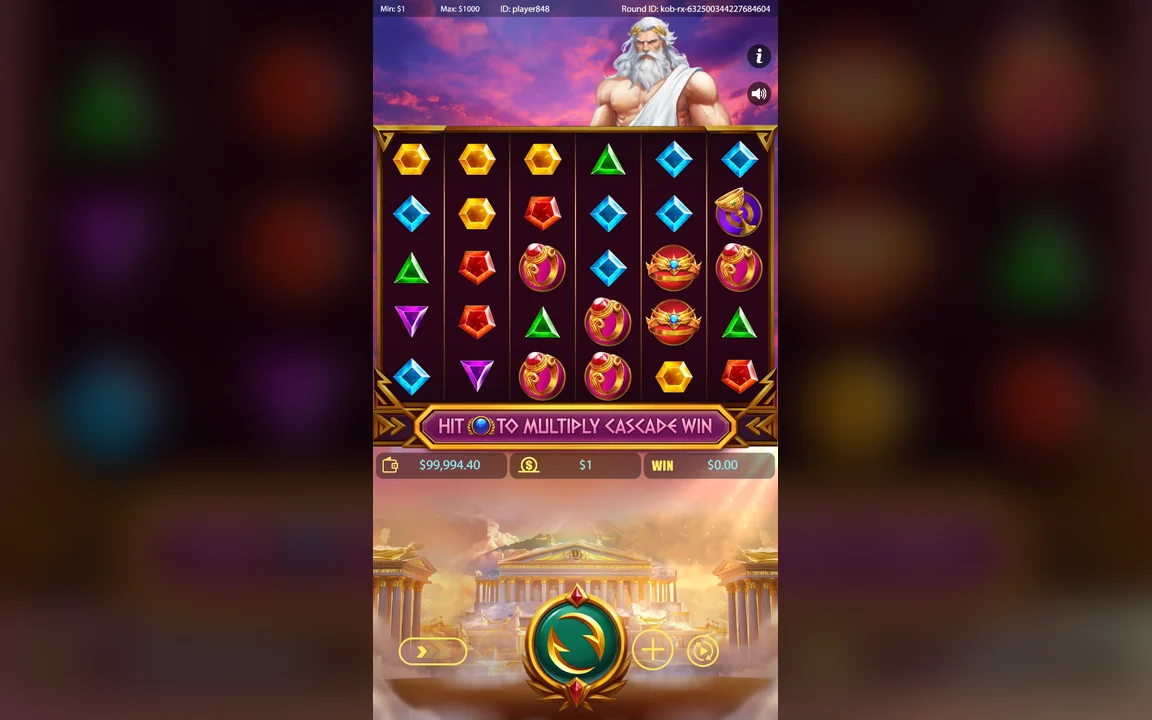
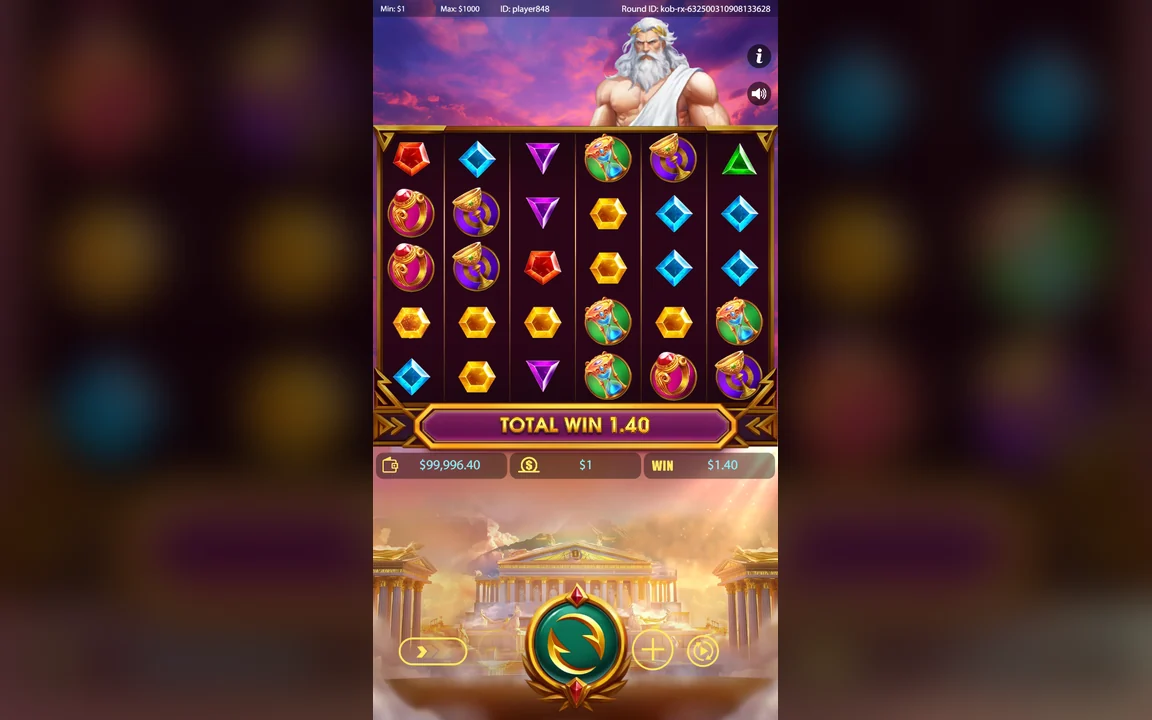
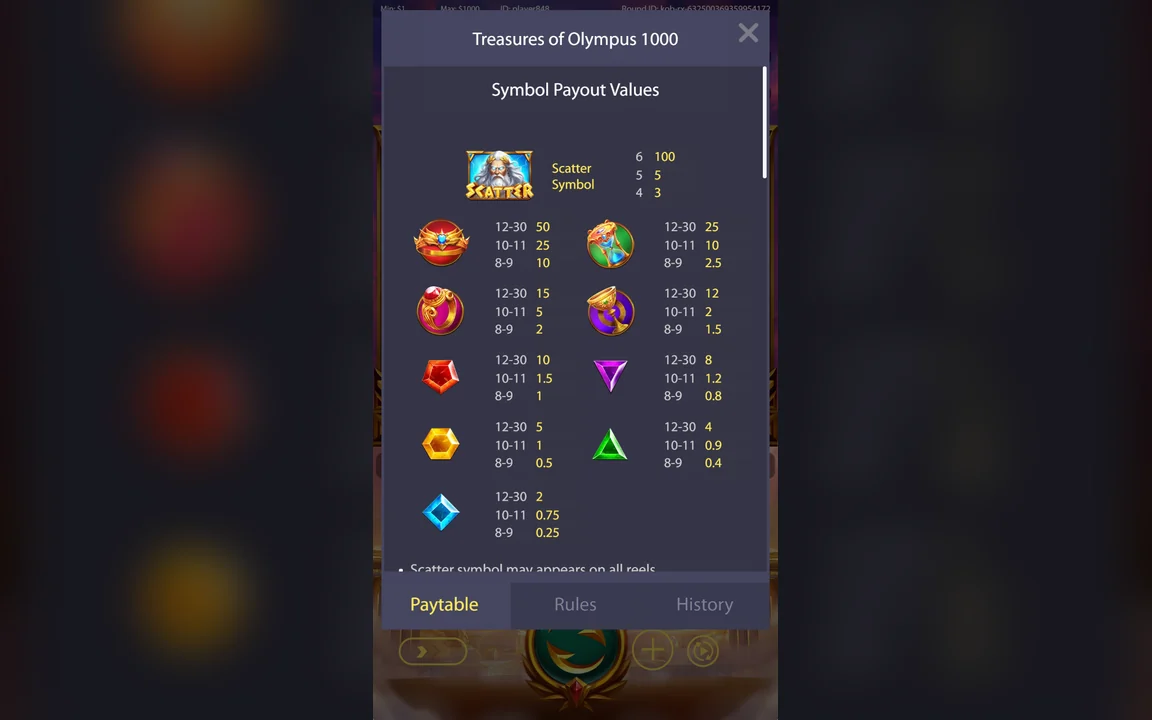
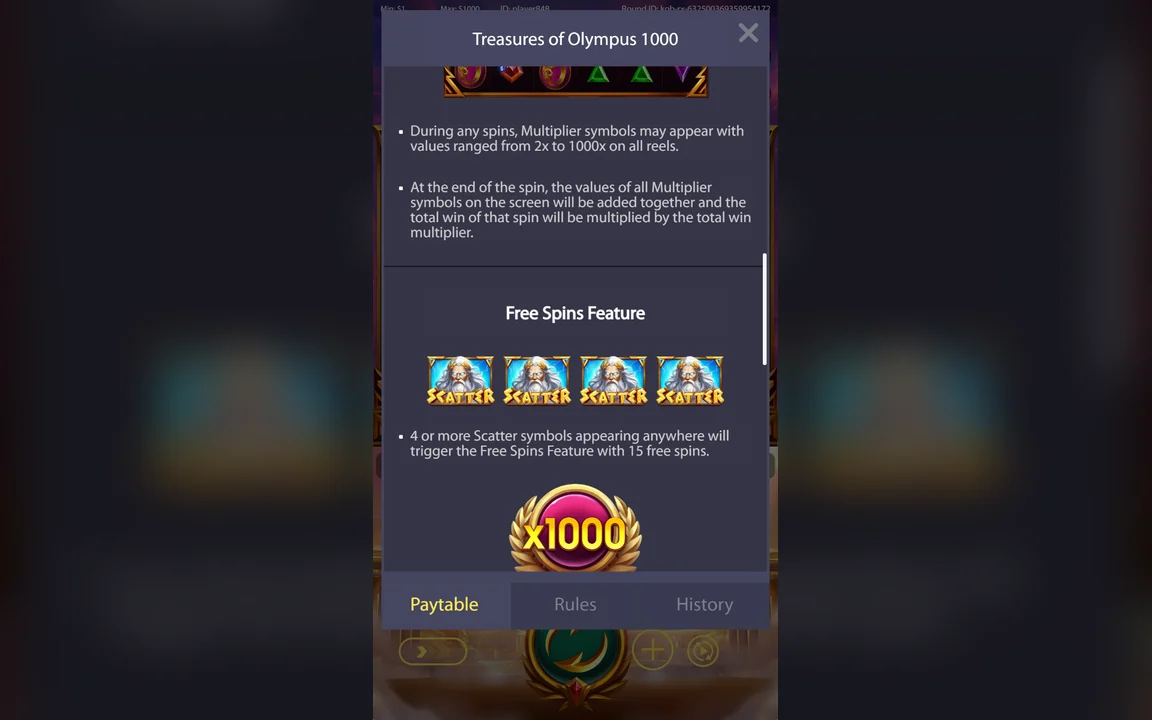
The images are our own captures from the provider's demo version of the game. The values in the tables above still come from our catalog data.
Game rules
 Game rules
Base game
The game runs on the provider's standard setup. The published return to player is —, and the volatility is listed as high.
Round extension
If more scatters land during the free spins round, it is extended with extra spins. That's the mechanic that makes long rounds possible.
Avalanche mechanic
The reels clear winning symbols and let new ones fall down from above. One paid combination can thus turn into a longer sequence.
Bonus buy
The bonus round can be bought directly for a fixed amount of the stake instead of waiting for scatters. The price is shown in the game's buy window — and some operators turn the feature off.
Cascades
Symbols in a win are removed, and new ones fall down instead. The chain continues as long as new wins are formed by the fallen symbols.
Free spins
The scatter symbols trigger a round of free spins. The number of spins and the required number of scatters are shown in the game's info panel and can vary slightly between operators.
Multipliers
The game uses multipliers that multiply the win they are part of. Where and when they can land is determined by the game's own paytable.
18+ · Play for entertainment, and set limits before you play. If you need help: stopspillet.dk / 70 22 28 25 — or self-exclude via ROFUS.
Key figures and payouts
| Key figures | Value in our catalog data |
|---|---|
| RTP according to catalog data | Not disclosed |
| Volatility | High |
| Max win | 15.000× |
| Ways to win | Not disclosed |
| Reel set | Not disclosed |
| Min. indsats | 1 € |
| Max. bet | Not disclosed |
| Win frequency | Not disclosed |
| Provider | King Midas Games |
| Released | 3. september 2025 |
The exact multiplier values per symbol count appear in the game's info panel and can vary with stake and operator. We reproduce only figures from our catalog data — not our own measurements in the game.
Payout table
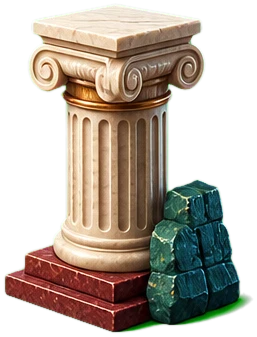 Payout table
The figures below were read directly on-screen from the game's own Symbol Payout Values table during our demo session, at a stake of 1 USD. If you change the stake, the amounts change accordingly.
| Symbol | Combination | Withdrawal at 1 USD |
|---|---|---|
| Red crown | 12-30 symbols | 50 USD |
| Red crown | 10-11 symbols | 25 USD |
| Red crown | 8-9 symbols | 10 USD |
| Green figure | 12-30 symbols | 25 USD |
| Green figure | 10-11 symbols | 10 USD |
| Green figure | 8-9 symbols | 2,5 USD |
| Red ring | 12-30 symbols | 15 USD |
| Red ring | 10-11 symbols | 5 USD |
| Red ring | 8-9 symbols | 2 USD |
| Purple ring | 12-30 symbols | 12 USD |
| Blue diamond | 12-30 symbols | 2 USD |
| Blue diamond | 10-11 symbols | 0,75 USD |
| Blue diamond | 8-9 symbols | 0,25 USD |
| Scatter | 6 symbols | 100 USD |
| Scatter | 5 symbols | 5 USD |
| Scatter | 4 symbols | 3 USD |
Multiplier symbols can land with values from 2x to 1000x on all reels, and their values are added together at the end of the spin.
Similar slots
More Olympus slots
 HOTOlympus RivalsAmigo GamingRTP not specified · Max 1.700×
 HOTRise of Olympus ExtremePlay'n GORTP 96,2 % · Max win 50.000×
 HOTOlympus GoldBetGamesRTP 96,53 % · Max 4.689×
 Olympus Mania: Hot BonusFugasoRTP 96,25 % · Max 3.000×
 Olympus Glory Gods & Kings LinkEGT DigitalRTP 96,5 % · Max 4.280×
 Olympus: Wine & WondersChampion StudioRTP not specified · Max 5.000×
 Zeus Legends of OlympusInspired GamingRTP 94,5 % · Max 1.000×
 Olympus Power LinkFugasoRTP 96,15 % · Max win 10.000×
 Unusual Suspects: Legends of OlympusNorthern Lights GamingRTP 96,06 % · Max win 12.000×
 Olympus Wins Super ScatterPragmatic PlayRTP 96,5 % · Max 100.000×
 Olympus Storm Connectify Pays Power ComboGold Coin StudiosRTP 96,33 % · Max 5.000×
 Glory of Olympus XmasGameTimeTecRTP 96,18 % · Max win 2.500×
 Bolt of OlympusUU SlotsRTP 96 % · Max 1.000×
 Fortune of OlympusPragmatic PlayRTP 96,55 % · Max 10.000×
 Olympus LightningWizard GamesRTP 96,08 % · Max win 2.295×
Same mechanics
 Supreme of OlympusBarbara BangRTP 96 % · Max win 15.000×
 Olympus ThunderholdRTGRTP 95,74 % · Max 2.500×
 Gods of Olympus: AresMount OlympusRTP 96,77 % · Max 5.000×
 Gods of Olympus: AphroditeMount OlympusRTP 96,89 % · Max 5.000×
 Zeus of OlympusPlayStarRTP not specified · Max not specified
 King of OlympusPlaytech OriginsRTP 95,47 % · Max 5.000×
 Sky of OlympusFormula SpinRTP 96,3 % · Max 15.000×
 Royalty of Olympus XmasBarbara BangRTP 96 % · Max win 15.000×
 Glory of Olympus: UnlockedGameTimeTecRTP 96,18 % · Max win 10.000×
 Games in Olympus 1000Pragmatic PlayRTP 95,51 % · Max 15.000×
 Olympus Bonanza ClawClawbusterRTP 95 % · Max 10.000×
 3 Combo OlympusFunky GamesRTP 96 % · Max win 15.000×
 Olympus TruewaysBGAMINGRTP 96,84 % · Max 5.000×
 Gates of Olympus Super ScatterPragmatic PlayRTP 96,5 % · Max 50.000×
 Lightning of OlympusSkywind GroupRTP 96,5 % · Max 15.000×
Same play profile
 Gates of OlympusPragmatic PlayRTP 95,51 % · Max 5.000×
 Chronicles of Olympus Assembl'emAlchemy GamingRTP 96 % · Max win 11.000×
 Greek Goddess: Siege of Olympus MegawaysPlayziaRTP 96,06 % · Max win 5.000×
 Olympus Coin LinkFugasoRTP 96,12 % · Max win 5.000×
 Rise of Olympus 1000Play'n GORTP 96,24 % · Max 60.000×
 Olympus ExplosionRubyPlayRTP 96,37 % · Max not disclosed
 Gems of OlympusGambitRTP 96,5 % · Max 5.000×
 Olympus DestinyAmigo GamingRTP not specified · Max 2.000×
 3 Pots of OlympusBetsoftRTP not specified · Max 13.685×
 Royalty of Olympus ExtremeBarbara BangRTP not specified · Max 15.000×
 Olympus Divine ReelsSpinberryRTP 93,18 % · Max not disclosed
 Olympus 7’s Dream DropRelax GamingRTP 94 % · Max 13.000×
 Olympus UnleashedPush GamingRTP 94,36 % · Max 2.340×
 Aphrodite Legends of OlympusInspired GamingRTP 94,5 % · Max 5.000×
 Rise of Olympus BingoPlay'n GORTP 96 % · Max win 5.000×
Frequently asked questions
 Frequently asked questions
What's the max win in Treasures of Olympus 1000?
15.000 times the stake according to the provider's sheet. The cap is at the high end of the Olympus pool and suits the game's high volatility.
Is the RTP disclosed?
No. The payout percentage is not stated in the available datasheet, neither for the base game nor for the buy feature. Look it up in the game's information screen.
How does the avalanche mechanic work?
Winning symbols are removed, and new ones fall into their place, so a single bet can produce multiple consecutive wins. The features list mentions both Avalanche and Cascading.
Who is behind the game?
King Midas Games, med udgivelsesdato 3. september 2025. The studio is not among the most widespread on the Danish market.
